

You Won’t Need a Marketer After 2027: How to Build an AI System That Sells, Analyzes, and Drives Decisions Automatically
التسويق الإلكتروني أصبح عامل أساسي في إستراتيجية أي مؤسسة
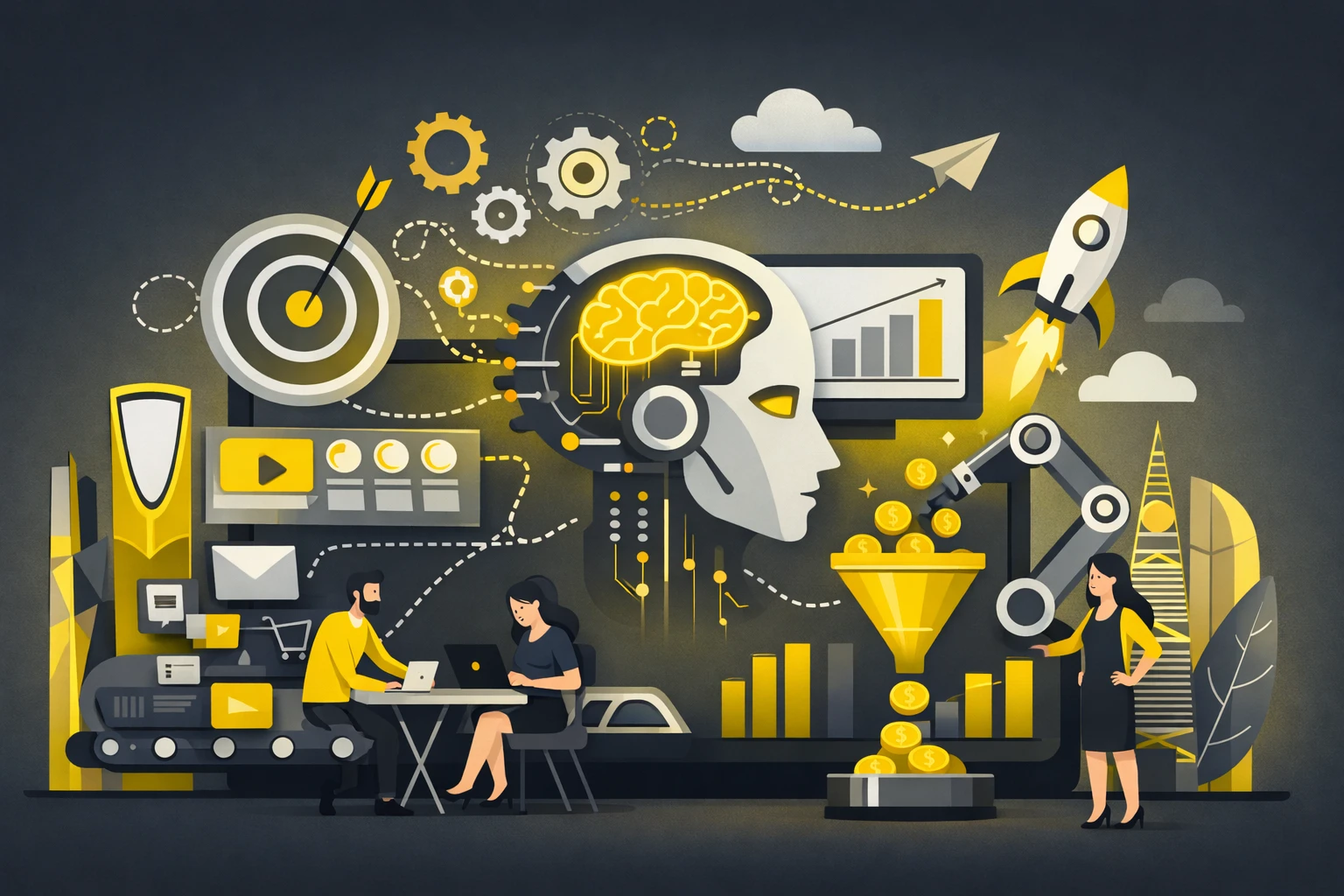

An article explaining how businesses can build an integrated AI system that automates marketing, sales, and analytics while keeping human strategy and decision-making at the center.
Over the past few years, marketing has changed significantly. It is no longer just about writing a good ad or running a paid campaign. It now depends on speed, data analysis, customer follow-up, message optimization, and making decisions daily based on performance indicators. With the expansion of AI-powered search tools and the rise of experiences such as AI Overviews and AI Mode in Google Search, access to information and brand discovery have become more closely tied to content quality, website structure, and data clarity, not just traditional campaigns alone.
But does this really mean that you will no longer need a marketer after 2027?
The more accurate answer is: you will not need the “same traditional form” of a marketer, but you will need an AI marketing system that performs dozens of tasks that used to be done manually. You will need an intelligent structure that gathers data, understands customer behavior, makes fast decisions, and continuously executes follow-up and optimization, while the human role remains focused on direction, strategy building, and refining the business message.
In other words, the future is not “without marketing,” but rather “marketing led by an intelligent system.”
Why is the market moving toward intelligent marketing systems?
Because the volume of data today is too large for one person to manage efficiently on an ongoing basis. You have multiple traffic sources, campaigns across more than one platform, WhatsApp messages, website forms, landing pages, CRM systems, and performance indicators that change every day. This is where an AI marketing system becomes important. It does not just display numbers; it connects them and turns them into actionable decisions.
Instead of waiting for an end-of-week report, the system can detect early that a certain campaign is bringing in a lot of traffic but weak conversions, or that a specific source is generating higher-quality customers, or that a particular follow-up message increases response rates more than others. This type of system does not just save time; it also reduces waste and increases response speed.
What is meant by an AI system that sells automatically?
We are not talking about a magical machine that completely replaces management. Rather, we mean an integrated system that performs the sales and marketing cycle in a semi-automated way, from the customer’s first visit to the final decision.
This system usually includes:
Receiving leads from the website, ads, WhatsApp, or forms
Automatically classifying customers based on source, interest, and readiness
Sending personalized replies and follow-ups
Analyzing customer behavior on the website or page
Suggesting the best offer, message, or follow-up timing
Measuring results and continuously updating recommendations
When it is built correctly, it does not function as a separate tool, but rather as an “operational brain” for marketing and sales.
How does AI build an integrated marketing and sales cycle?
1) Collecting data from every touchpoint
The first step in building any successful system is data unification. AI cannot make good decisions if your data is scattered across Excel sheets, WhatsApp, ad platforms, and sales systems.
That is why the system starts by connecting all channels in one place:
the website, contact forms, CRM, advertising campaigns, calls, conversations, and even actual sales results.
At this point, marketing shifts from being “scattered activities” into a “clear customer journey.”
2) Understanding the customer instead of just collecting them
Many companies collect a large number of leads, but they do not know which ones deserve follow-up first. Here, AI uses intelligent lead scoring to rank prospects according to their probability of conversion, real interest, behavior on the website, and speed of interaction.
This way, the team does not waste time treating every customer the same. Instead, it prioritizes the highest-value opportunities.
3) Personalizing messages and offers
One of the biggest differences between traditional marketing and AI-powered marketing is that the message is not the same for everyone. The intelligent system can adjust the wording of messages, follow-up offers, or page content according to the customer type and stage.
A cold lead needs education.
A hesitant lead needs reassurance.
A ready lead needs a clear and fast offer.
This point in particular is what makes the system truly “sell,” because it does not send the same message to everyone.
4) Continuous analysis instead of delayed reports
Traditional marketing often discovers the problem after it happens. An intelligent system, on the other hand, monitors performance almost in real time and detects declines or new opportunities faster.
If conversions drop on a certain page, acquisition costs increase from a specific channel, or lead quality improves from a particular campaign, the system can alert the team or suggest a direct adjustment.
At that point, analysis becomes more than just reading numbers. It becomes a driver of decisions.
5) Making decisions based on patterns
AI does not just tell you what happened. It also tries to explain why. For example:
It may notice that leads coming from educational content convert better than leads coming from direct advertising.
Or that replying within the first 10 minutes increases the likelihood of closing the deal.
Or that a certain page achieves high time-on-page, but has a weak CTA.
These patterns are the basis of intelligent decision-making, and they are what make the system more valuable than a simple dashboard.
Does this mean the marketer’s role will disappear?
Not entirely.
What will most likely disappear is the repetitive executional role:
manual reporting, manual classification, scheduling follow-ups, monitoring channels, rewriting similar messages, and extracting numbers from multiple platforms.
What remains, and becomes even more important, is:
strategy, offer building, market understanding, brand positioning, major decision-making, and creating the experience that differentiates you from competitors.
AI will replace many “marketing tasks,” but it will not replace the need for the “commercial mind” that directs it.
What are the actual components of an AI marketing system?
If you want to build a practical system within your company, think of it as six layers:
Layer One: Data Sources
This includes the website, ads, CRM, WhatsApp, email, and points of sale.
Layer Two: Tracking and Measurement
This includes UTM parameters, event tracking, conversion measurement, and connecting lead sources to actual sales.
Layer Three: Data Warehouse
A unified place where data is collected and prepared for analysis.
Layer Four: AI Engine
This is where classification, prediction, recommendation, and message or summary generation take place.
Layer Five: Automated Execution
Such as sending follow-ups, assigning leads to the team, alerting management, or adjusting messages.
Layer Six: Decision Dashboard
This is the interface that shows you what is happening now and what you should do next.
Which companies benefit the most from this type of system?
The biggest beneficiaries are usually:
Companies that rely on leads daily
Clinics and medical centers
Service companies
SaaS companies
Stores that want to understand the customer journey accurately
Agencies managing multiple campaigns and multiple clients at the same time
These organizations usually suffer from the same problem:
the data exists, but decision-making is slow or fragmented.
If you are asking, “Will I need a marketer after 2027?”
The better question is: “Do you still want your marketing to remain dependent on manual work?”
The future is moving toward companies that own an AI marketing system, not just separate tools.
A system that gathers your data, understands your customer, follows up on opportunities, analyzes performance, and drives decisions at the right time.
Whoever starts building this system now will not only become more efficient, but will also move closer to sustainable growth, reduced waste, and faster, more accurate decision-making.
How do you get started without complexity or huge cost?
Contact Cayan and subscribe to GoWeb.
An integrated system that meets your needs. Learn more.
Frequently Asked Questions
Can AI completely replace a marketing team?
No, but it reduces dependence on repetitive manual tasks and gives the team more room for strategy, creativity, and major decisions.
What is the first step in building an AI marketing system?
Unifying data and connecting lead sources with sales in one place, because any later analysis or automation depends on the quality of this stage.
Is this system suitable for small businesses?
Yes, if it starts gradually and is focused on solving a specific problem such as lead follow-up or analyzing conversion sources.
Does AI-generated content harm SEO?
Not necessarily. Google focuses on content quality, usefulness, and trustworthiness, not only on how the content is produced. However, it does warn against using AI to create large volumes of pages with no real value for the user.

